|
|
| Abstract.
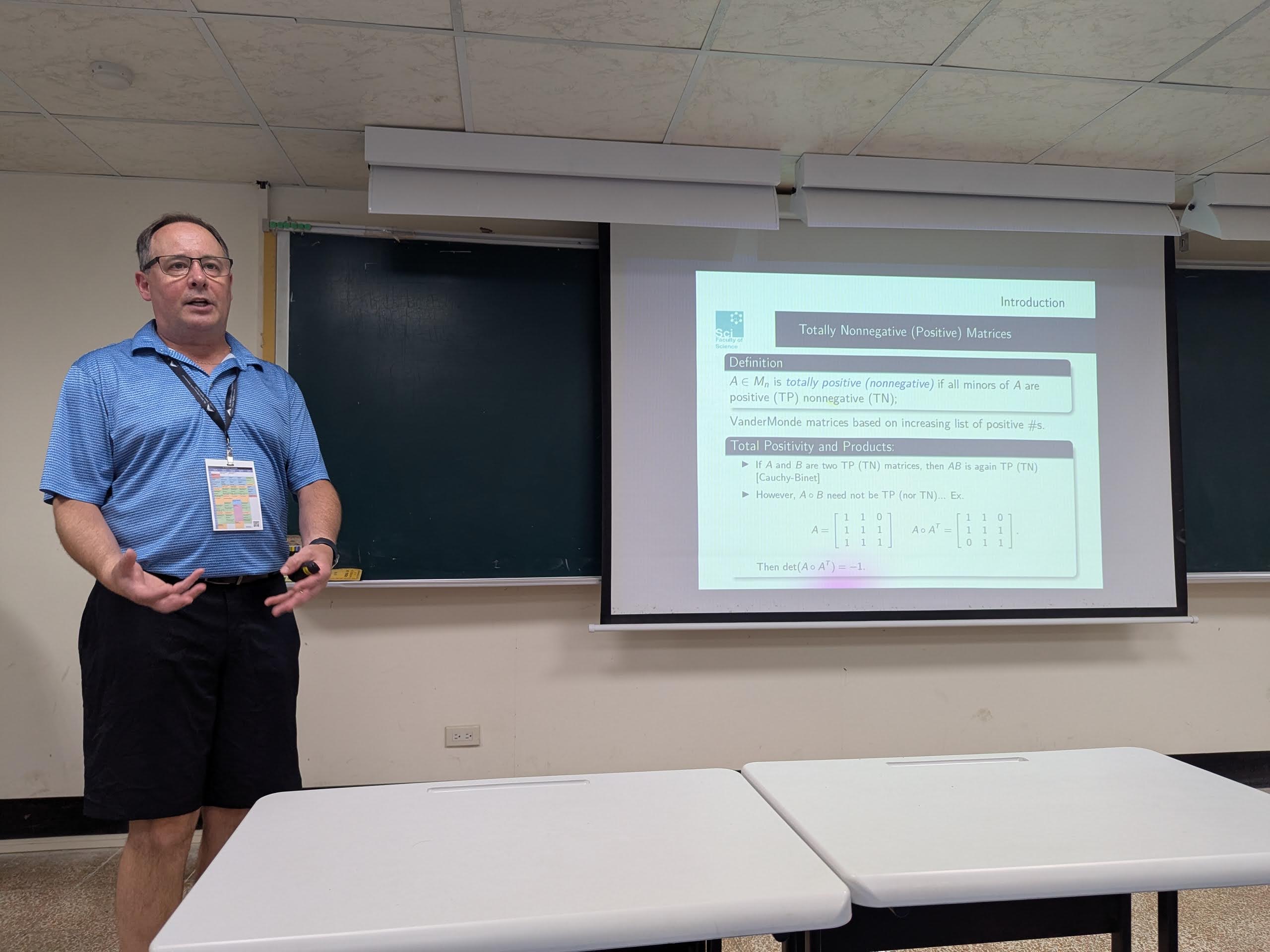
A matrix is called totally nonnegative (positive) if all its minors are
nonnegative (positive). In this talk we consider functions that preserve
that class of totally nonnegative (positive) matrices. This subject has
rightfully received significant attention over the years, including
previous studies on characterizing surjective linear preservers and more
recent interesting inquiries into various types of entry-wise preservers
for this class of matrices. Building upon the basic fact that the class
of totally nonnegative (positive) matrices forms a semigroup we highlight
some existing work and investigate and report on some recent progress
concerning multiplicative maps that preserve this semigroup of positive
matrices.
|
|
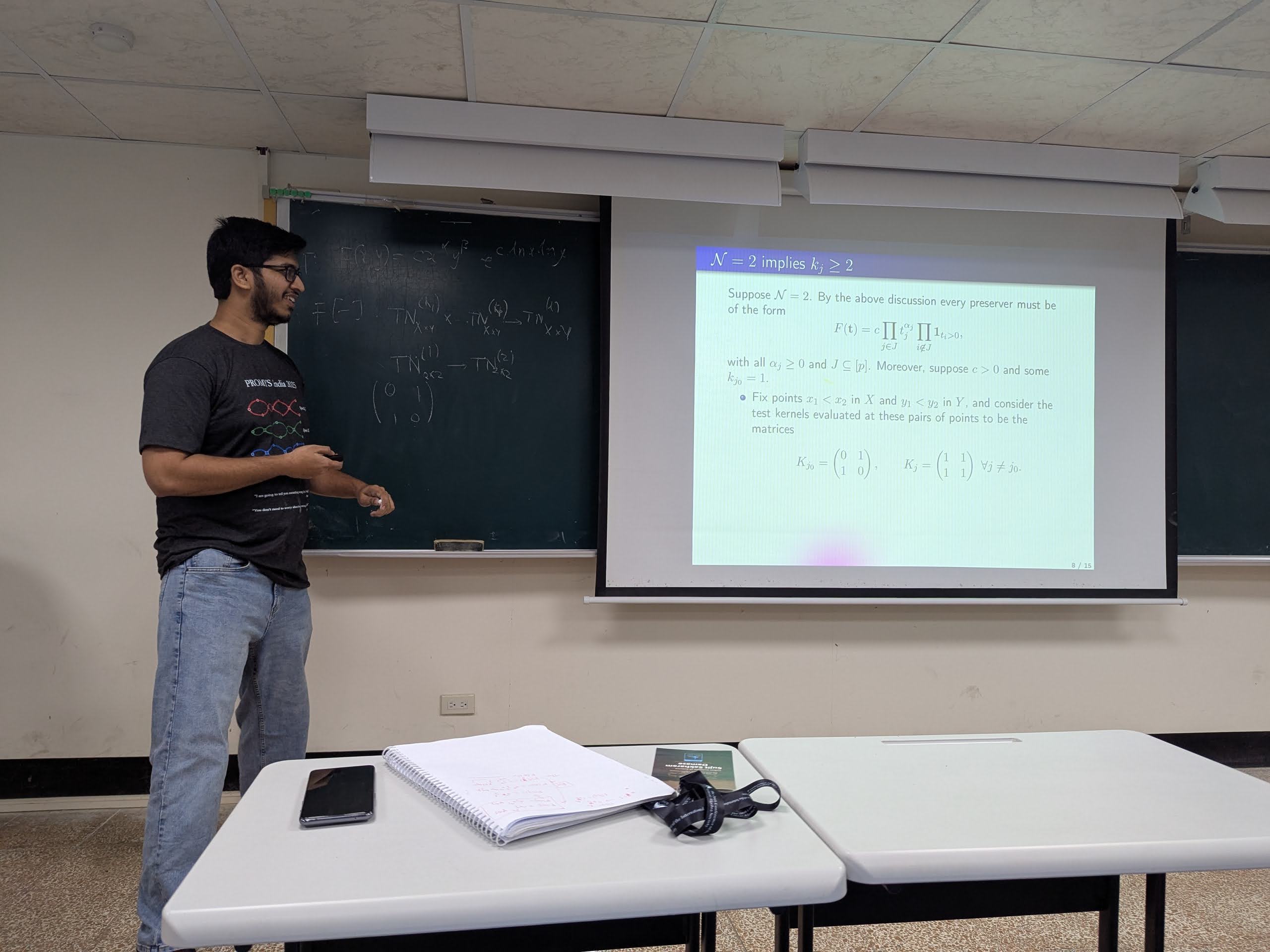
| Abstract.
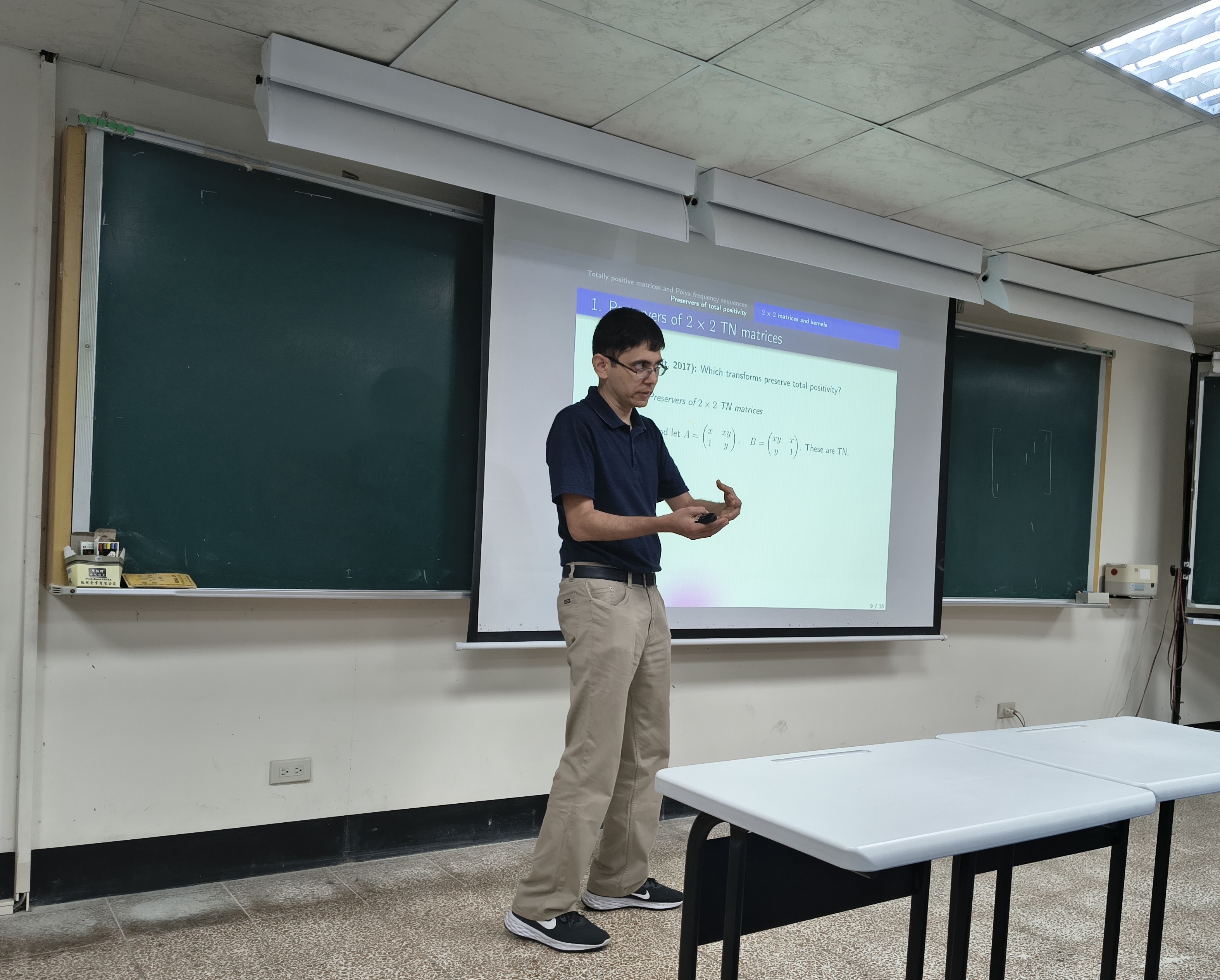
We will discuss recent results on preservers of totally
positive/nonnegative matrices and kernels, together with some
observations that go into their proofs. Partly joint with Alexander
Belton, Dominique Guillot, and Mihai Putinar.
|
|
| Abstract.
We will discuss recent results on multivariate transforms of totally
positive/nonnegative matrices and kernels, together with some
observations that go into their proofs. This is a joint work with Apoorva
Khare.
|
|
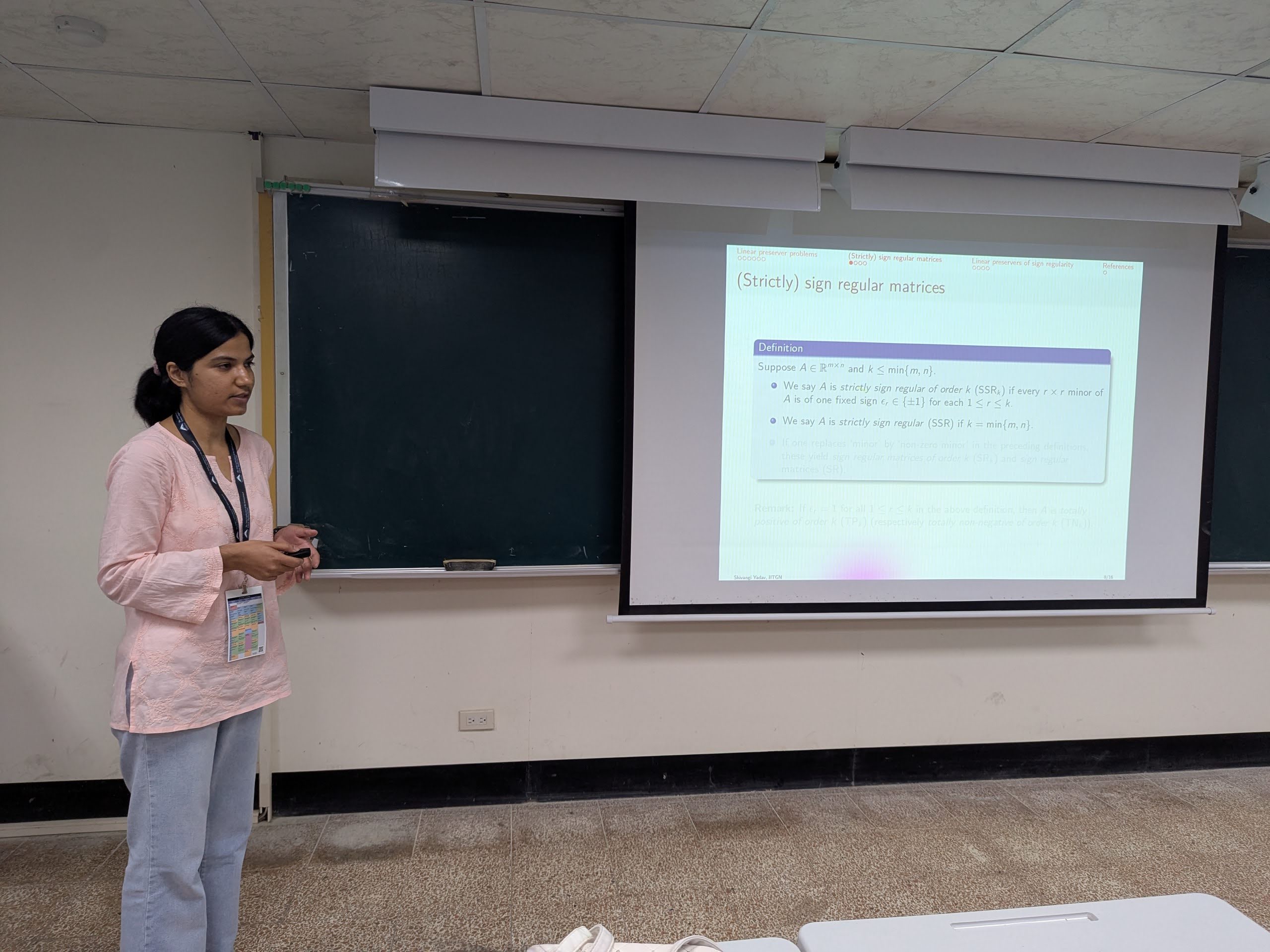
| Abstract.
The classification of linear maps on a space of bounded linear operators
that preserve certain functions, subsets, relations, etc. has a long
history beginning, with Frobenius, who characterized in 1897 the linear
maps on matrix algebras which were determinant-preserving. In this talk,
I will present a classification of all surjective linear mappings
$\mathcal{L}:\mathbb{R}^{m\times n}\to\mathbb{R}^{m\times n}$ that
preserve: (i) sign regularity and (ii) sign regularity with a given sign
pattern, as well as (iii) strict versions of these. As a special case of
our results, we characterize linear preservers for the class of square
totally positive and totally non-negative matrices, which were studied by
Berman–Hershkowitz–Johnson in 1985. This is a joint work with
Projesh Nath Choudhury.
|
|
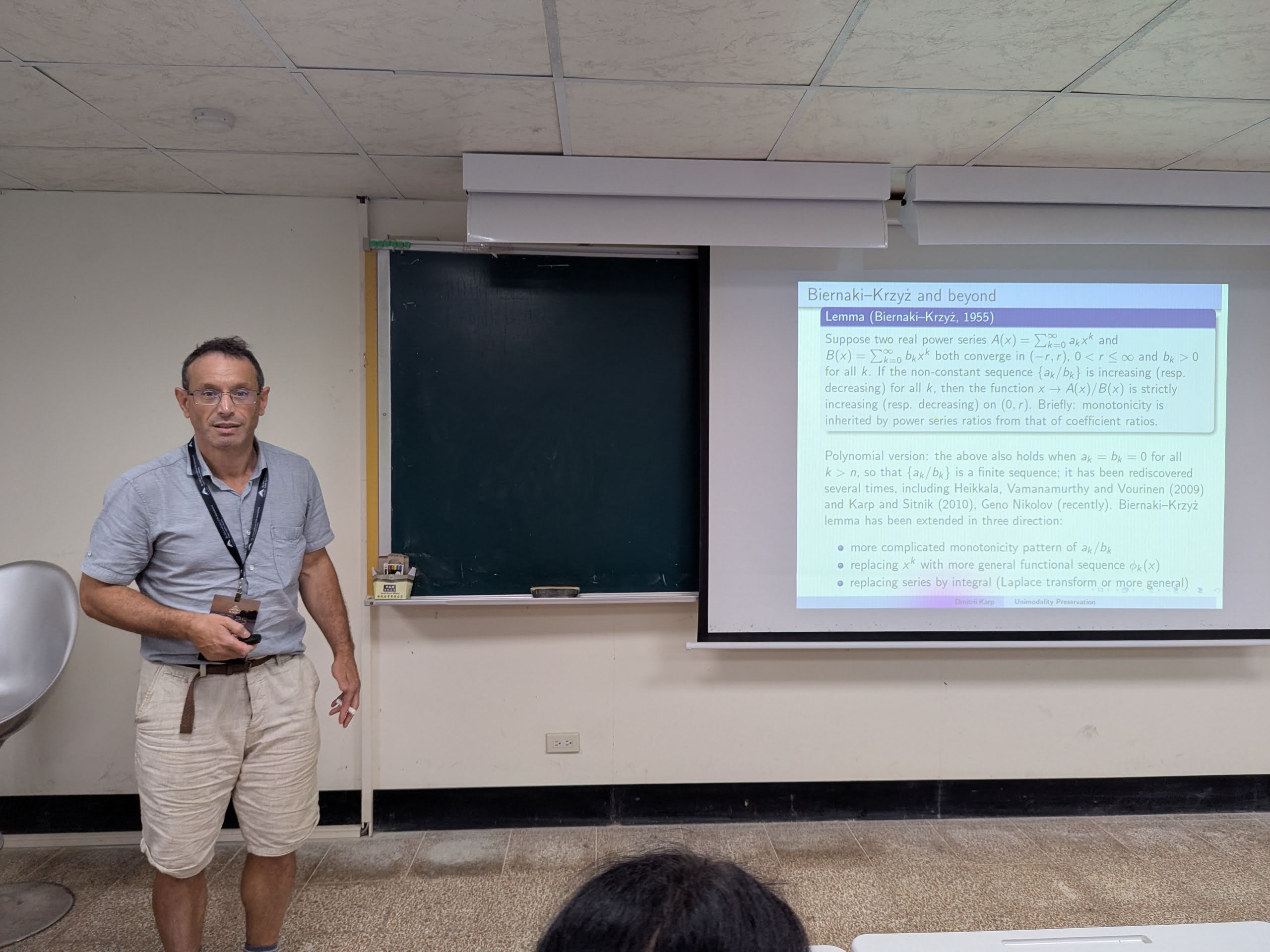
| Abstract.
An elementary, but very useful lemma due to Biernacki and Krzyz
(1955) asserts that the ratio of two power series inherits monotonicity
from that of the sequence of ratios of their respective coefficients.
Over the last two decades it has been realized that, under some
additional assumptions, similar claims hold for more general ratios of
series and integral transforms as well as for unimodality in place of
monotonicity. In the talk, we discuss conditions on the functional
sequence and the kernel of an integral transform ensuring the
preservation property. Numerous series and integral transforms appearing
in applications satisfy our sufficient conditions, including Dirichlet,
factorial (and $q$-factorial) series, inverse factorial series, Laplace,
Mellin and generalized Stieltjes transforms, among many others. We
illustrate our results by ratios of generalized hypergeometric functions
and Nuttall's $Q$ functions. The key role in our considerations is
played by the notion of sign regularity.
The talk is based on joint work with Anna Vishnyakova and Yi
Zhang.
|
|
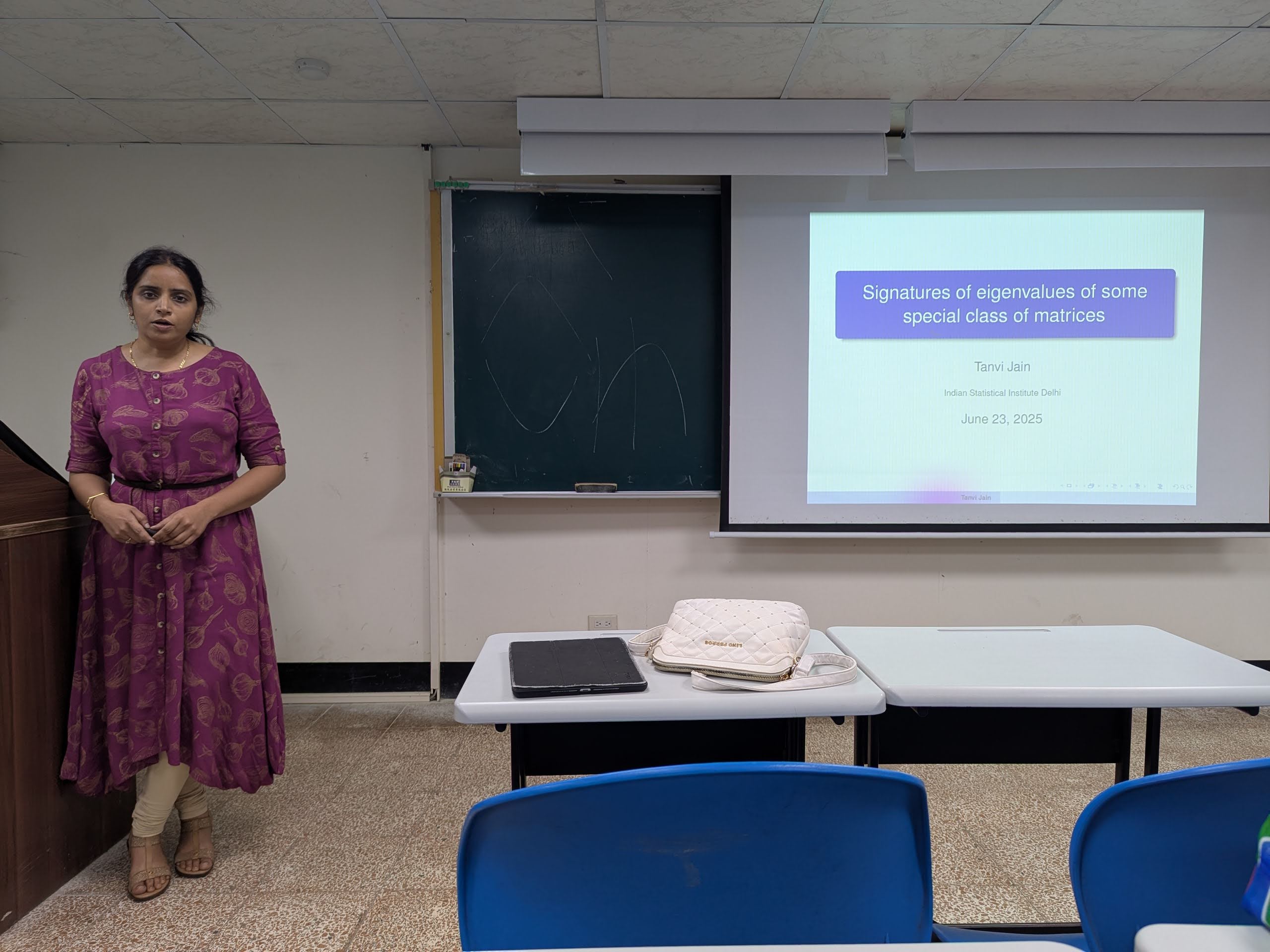
| Abstract.
Let $r$ be any real number and for any $n$ let $p_1,\ldots,p_n$ be
distinct positive numbers. A Kwong matrix is the $n\times n$ matrix whose
$(i,j)$ entry is $(p_i^r+p_j^r)/(p_i+p_j).$ We determine the signatures
of eigenvalues of all such matrices. We especially focus on eigenvalue
behaviour with respect to another class of matrices – Loewner
matrices, and discuss the differences in strict sign regularity of these
two classes of matrices. This is based on a joint work with Rajendra
Bhatia.
|
|
| Abstract.
Let $P,P(0)>0$ be a real polynomial of degree $m$. It is easy to check that
\begin{equation}
\sum_{k=0}^\infty P(k) x^k =\frac{Q_m(x)}{(1-x)^{m+1}},
\end{equation}
where $Q_m$ is a real polynomial of degree at most $m$.
We will discuss the following problem: for which $P$ the sequence
$(P(k))_{k=0}^\infty$ is totally positive? According to the famous
theorem by Aissen, Schoenberg, Whitney and Edrei it happens if and only
if all the zeros of $Q_m$ are real and non-positive.
The following statement is one of our results:
Let $P(x) =(x+\alpha_1)(x+\alpha_2)\cdot \ldots \cdot (x+\alpha_m),$
where $0\leq \alpha_1 \leq \alpha_2 \leq \ldots \leq \alpha_m,$ and for
every $j=1, 2, \ldots, m-1$ we have $ \alpha_{j+1} - \alpha_j \leq 1.$
Then the sequence $(P(k))_{k=0}^\infty$ is totally positive.
We will also discuss the sequences of the form
$\left((1-c_1 q^k)(1-c_2 q^k)\cdot \ldots \cdot (1-c_m q^k)
x^k\right)_{k=0}^\infty,$
where $0< q < 1, q< c_j < 1.$
The talk is based on joint work with Dmitrii Karp and, partially, Thu
Hien Nguyen.
|
|
| Abstract.
A real sequence $(b_k)_{k=0}^\infty$ is called totally positive if all
minors of the infinite matrix $\| b_{j-i} \|_{i,j=0}^\infty$ are
nonnegative (here $b_k = 0$ for $k<0$). We investigate the following
problem posed by Alan Sokal: to describe the set of sequences
$(a_k)_{k=0}^\infty$ such that for every totally positive sequence
$(b_k)_{k=0}^\infty$ the sequence $(a_k b_k)_{k=0}^\infty$ is also
totally positive. We obtain the description of such sequences
$(a_k)_{k=0}^\infty$ in two cases: when the generating function of the
sequence $\sum_{k=0}^\infty a_k z^k$ has at least one pole, and when the
sequence $(a_k)_{k=0}^\infty$ has no more than 4 nonzero terms.
|
|
| Abstract.
In this talk the bidiagonal decomposition of the Collocation Matrices of
$q$-Jacobi Polynomials will be presented. In addition, it will be shown
that this bidiagonal decomposition can be constructed with high relative
accuracy (HRA) in many cases. Then, for these cases, the bidiagonal
decomposition will be used to solve with HRA the following linear algebra
problems: computation of the inverse, the eigenvalues and the singular
values of those collocation matices, and the solution of some related
linear systems of equations.
This is a joint work with Héctor Orera and Juan Manuel
Peña.
|