|
|
| Abstract.
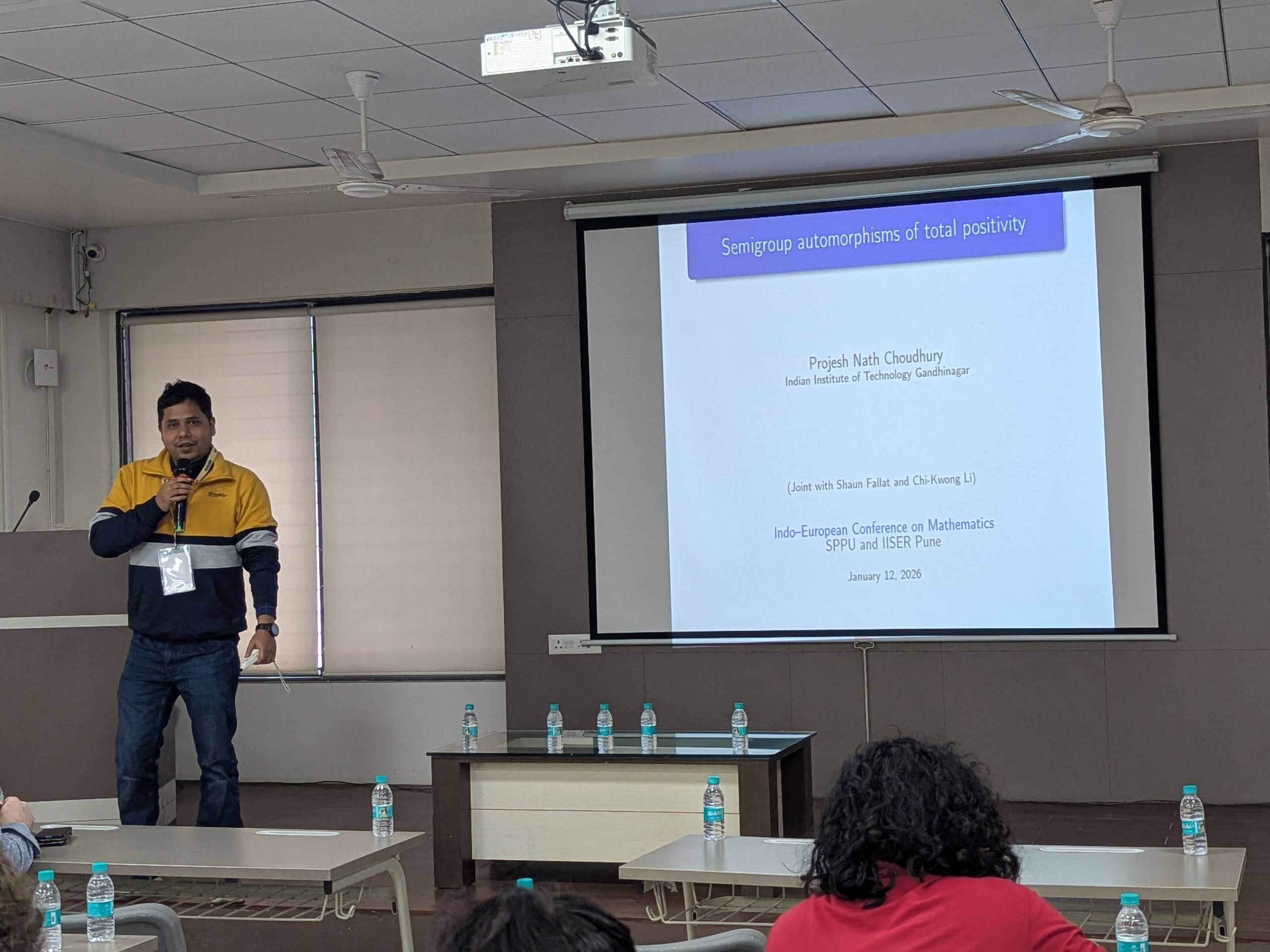
Totally positive (TP) matrices connect to analysis, mechanics, and to
dual canonical bases in reductive groups, by well-known works of
Schoenberg, Gantmacher–Krein, Lusztig, and others. These matrices
form a multiplicatively closed semigroup, contained in the larger monoid
of invertible totally nonnegative (ITN) matrices. Whitney and
Berenstein–Fomin–Zelevinsky found "multiplicative generators"
of $n \times n$ ITN and TP matrices; a natural question now is to
classify the multiplicative automorphisms of these semigroups. We present
a complete solution to this question. (Joint work with Shaun Fallat and
Chi-Kwong Li.)
|
|
| Abstract.
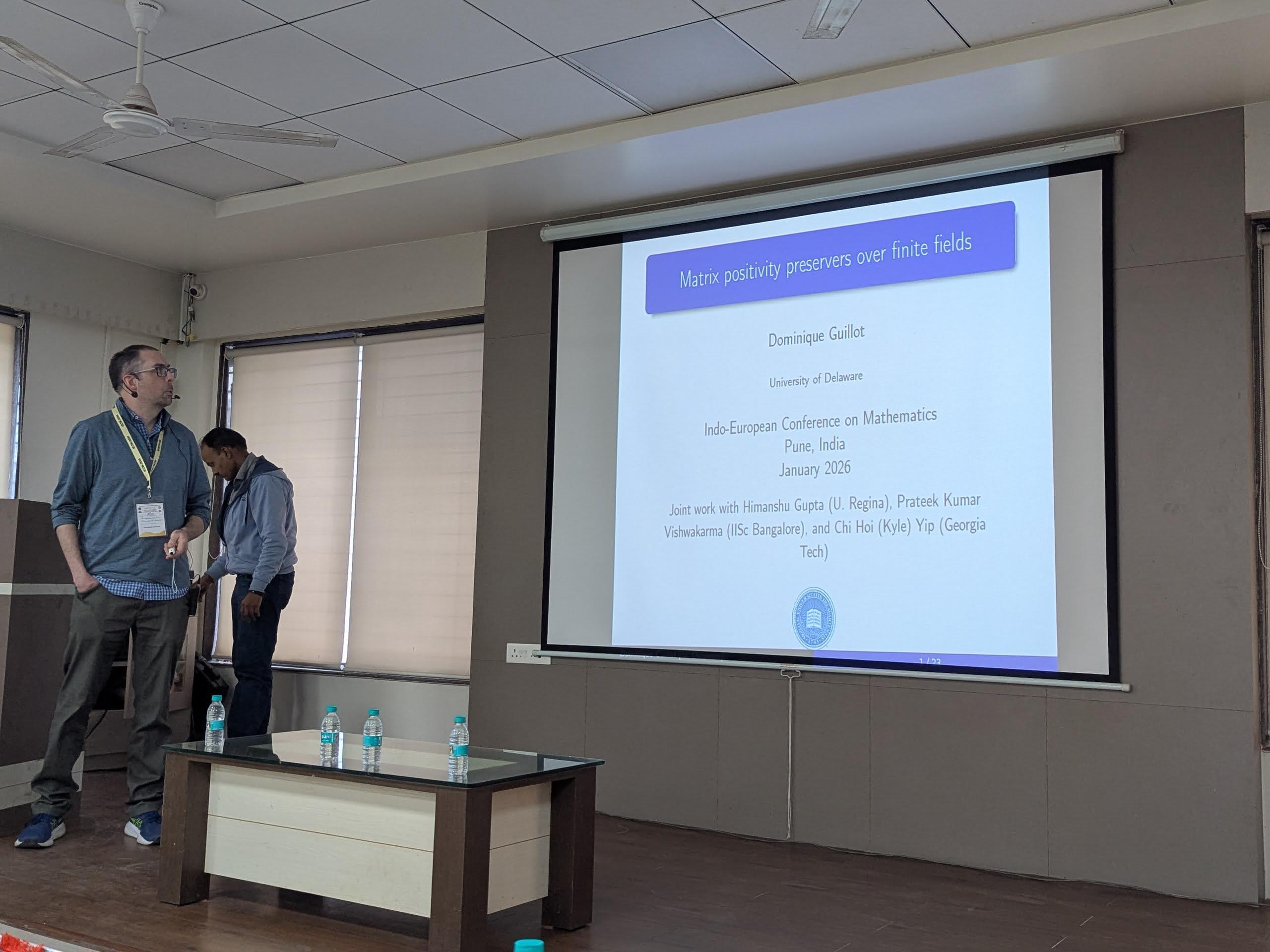
We resolve an algebraic version of Schoenberg's celebrated theorem
characterizing the functions $f$ with the property that the matrix
$(f(a_{ij}))$ is positive definite for all positive definite matrices
$(a_{ij})$. Compared to the classical real and complex settings, we
consider matrices with entries in a finite field. Here, we say that such
a matrix is positive definite if all its leading principal minors are
non-zero quadratic residues. We obtain a complete characterization of
entrywise positivity preservers in that setting for matrices of a fixed
dimension. When the dimension of the matrices is at least 3, we prove
that, surprisingly, the positivity preservers are precisely the positive
multiples of the field's automorphisms. Our proofs build on several novel
connections between positivity preservers and field automorphisms via the
works of Weil, Carlitz, and Muzychuk–Kovács, and via the
structure of cliques in Paley graphs. (Joint work with Himanshu Gupta,
Prateek Kumar Vishwakarma, and Chi Hoi Yip.)
|
|
| Abstract.
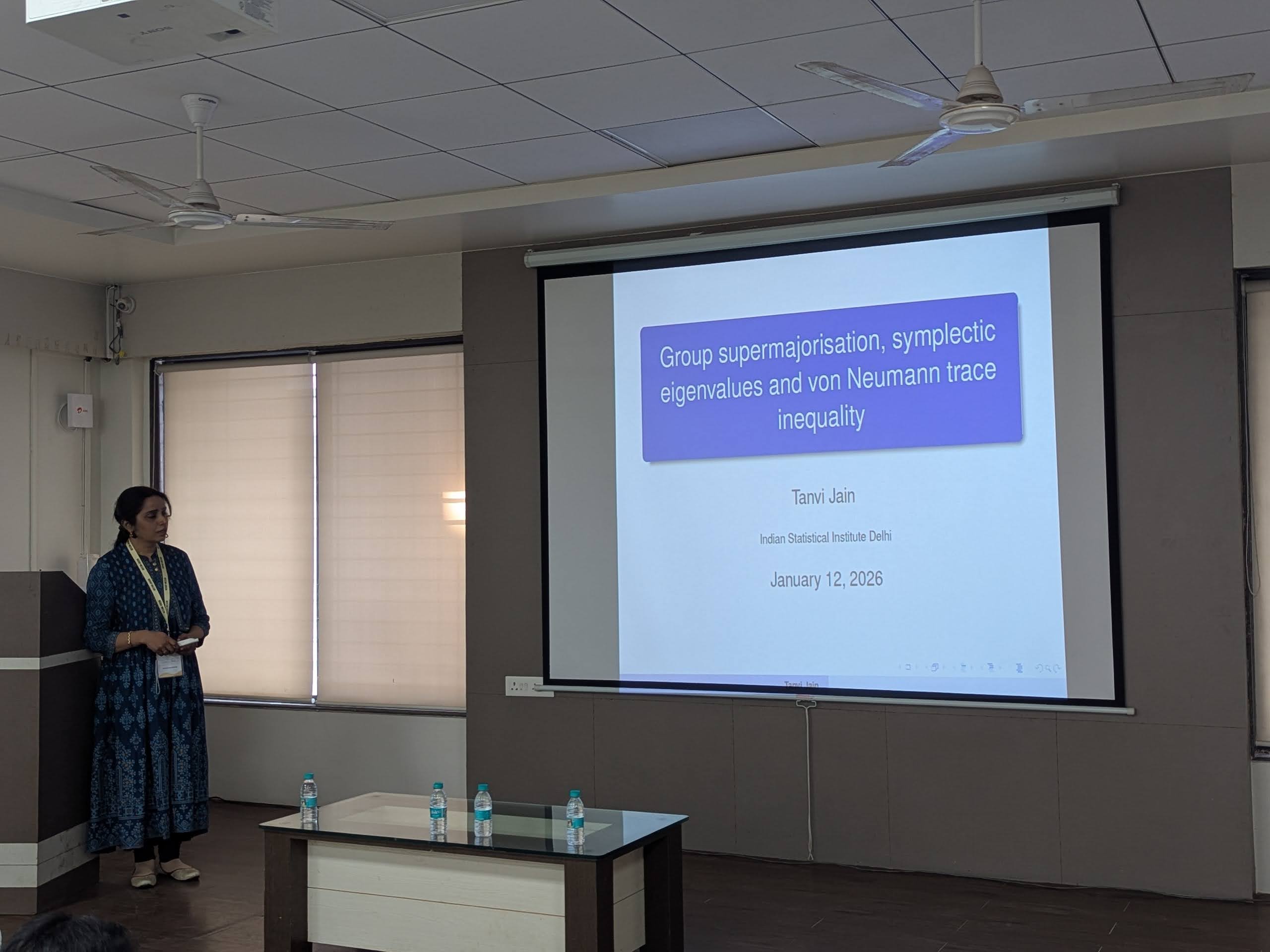
For every real positive definite matrix $A$ of order $2n$, there exists a
symplectic matrix $M$ such that $MAM^T = diag(D,D)$ where $D$ is a
positive diagonal matrix of order $n$. The diagonal entries of $D$ are
called the symplectic eigenvalues of $A$. These characterise the orbit of
$A$ under the action of symplectic group as the eigenvalues of $A$
characterise the orbit of $A$ under the action of orthogonal group.
Symplectic eigenvalues play an important role in various areas of physics
and mathematics – quantum mechanics, quantum information theory and
symplectic geometry. It is remarkable to see that many results on
eigenvalues have their symplectic analogues. In this talk we extend the
concept of group majorisation to group super-majorisation. This
generalises weak super-majorisation. We use this to derive the symplectic
version of the classical von Neumann trace inequality.
|
|
| Abstract.
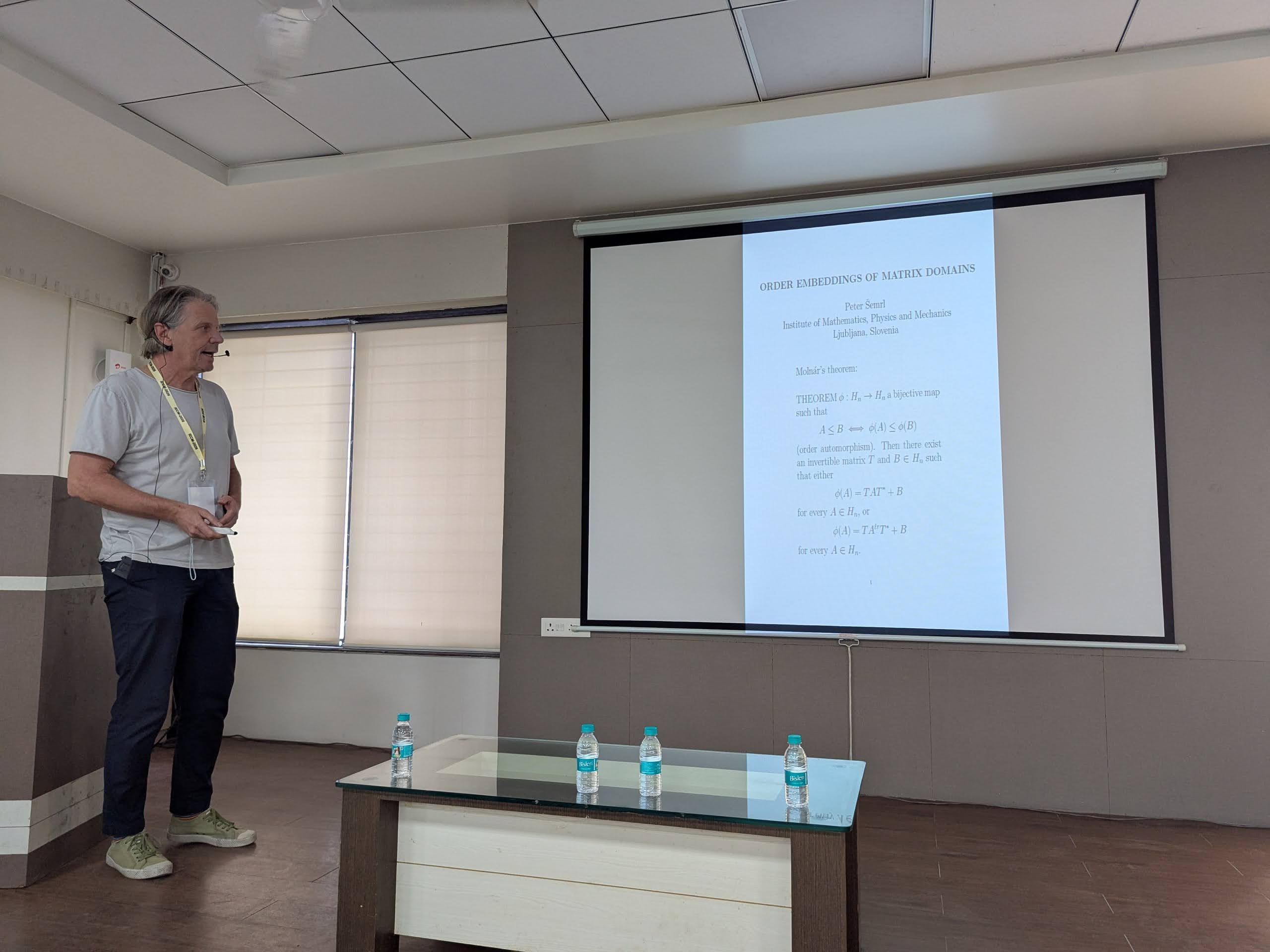
Let $H_n$ be the set of all $n\times n$ hermitian matrices equipped with
the usual Loewner's order. A subset $U \subseteq H_n$ is called a matrix
domain if it is open and connected, and a map $\phi : U \to H_n$ is said
to be an order embedding if for every pair $A,B \in U$ we have
\begin{equation}
A \le B \iff \phi (A) \le \phi (B).
\end{equation}
We will present some results on the general form of such maps and explain
some of the main ideas used in the proofs.
|
|
| Abstract.
Schoenberg's theorem characterizes positive definite zonal kernels on the
Euclidean sphere as precisely the non-negative linear combinations of
Gegenbauer polynomials. In this talk, I will explain how this
characterization leads to the linear programming method of
Delsarte–Goethals–Seidel / Kabatiansky–Levenshtein for
bounding spherical codes, and how these bounds give upper bounds for
sphere packing densities. I will then outline the Cohn–Elkies
approach to sphere packing, emphasizing the role of radial positive
definite functions, and briefly discuss how Viazovska's Fourier
interpolation method produces sharp bounds in dimensions $8$ and $24$. In
the final part of the talk, I will describe recent joint work with James
Pascoe that extends Schoenberg's framework to partially defined
positivity preservers on discrete domains. I will also explain how this
viewpoint sheds light on constrained spherical codes and linear
programming bounds.
|
|
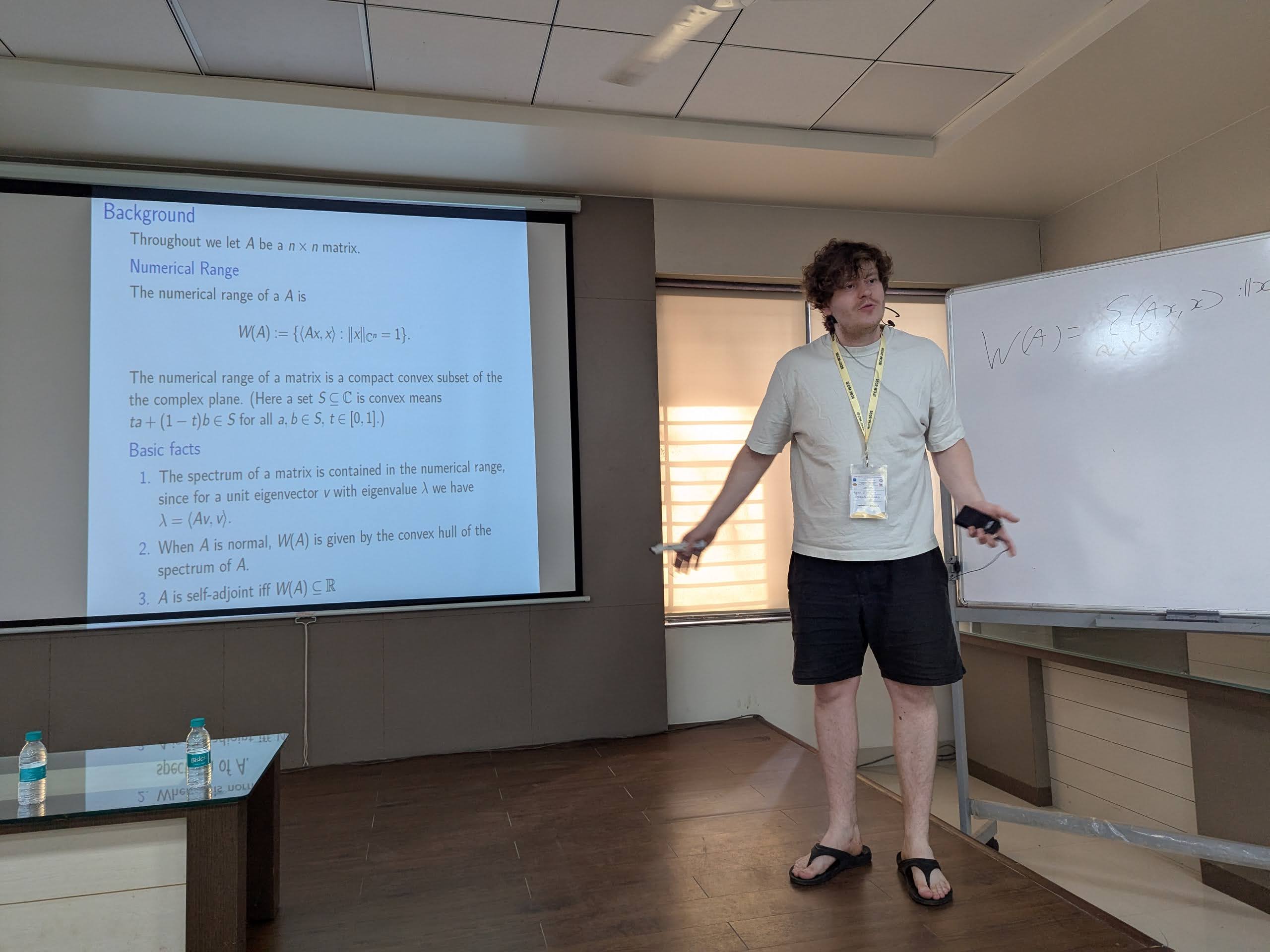
| Abstract.
Crouzeix's Conjecture is an open conjecture which claims that the
operator norm of a polynomial applied to a matrix is bounded above by 2
times supremum of the polynomial over the numerical range of the matrix.
In this talk I will first give a historical background on Crouzeix's
Conjecture starting from the von Neumann inequality, and then present
some new recently published results on the conjecture.
|